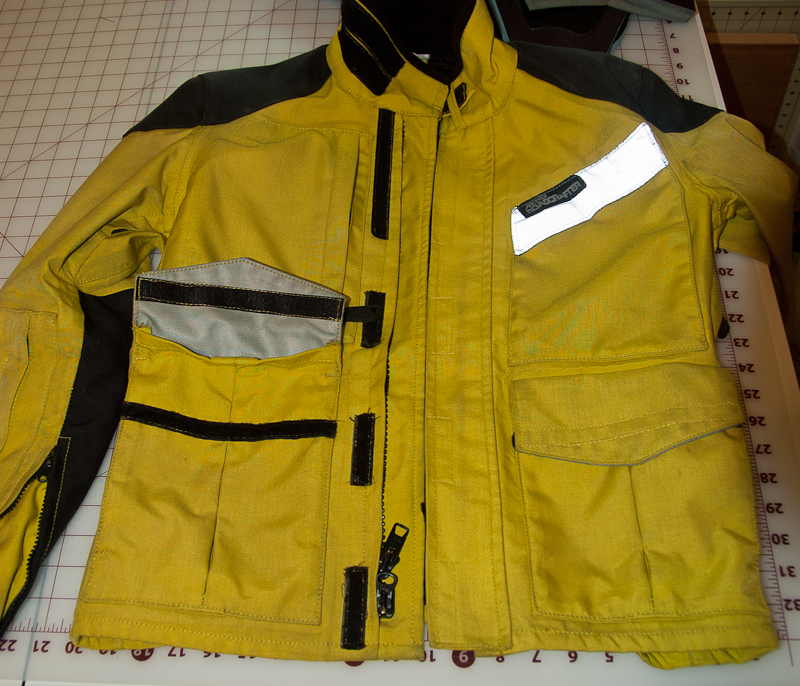
I’ve come up with a fairly effective way of cleaning my motorcycle jackets and pants after they have accumulated a good layer of highway grunge. I’ve used the same method on both an Aerostich Roadcrafter and an Olympia Mesh jacket and pants and it works equally well on both.
I use Dawn Power Dissolver since it’s an incredible product for cutting through and removing grease and oil. I hate to sound like a commercial, but have an oil stain you accidentally washed into a shirt months ago? Buy Power Dissolver, spray the oil stain, wash in warm water. The stain will be gone.
As for the effect Power Dissolver has on the Gore-Tex — I have worn my Aerostich while riding for a full day in torrential rain after cleaning with the following method and stayed bone dry. Looking good is less important to me than staying dry. And yes, I realize anyone with half a brain wouldn’t ride for a full day in torrential rain.
Summary of Cleaning Steps
- Empty all the pockets
- Remove all the protective pads
- Pre-soak
- Scrub
- Rinse in tub
- Rinse in washer
- Wash
- Dry
- Waterproofing
- Zipper maintenance
- Replace pads and put things back in pockets
Detail of Method and Products
Step 1. Empty all the pockets. Don’t laugh — I’ve almost washed some important stuff.
Step 2. Remove all the protective pads. You do not want to get soapy water in your pads. If you want to clean them just rinse with warm water, but be warned — it will take them forever to dry. I learned that one the hard way. The first time I removed the pads I used a permanent marker to initial them with their location. I figured they’d somewhat molded to my body and I wanted the right side pads back in the right and the left ones on the left.
Step 3. Pre-soak – put the jacket and pants in the bathtub and thoroughly spray with Dawn Power Dissolver and let it soak for 30 minutes. A sink isn’t big enough, so the tub gives you room to work.
Step 4. Scrub – put hot water in a container (to assist with oil cutting) and a little Dawn dish washing soap (also a grease cutter). The Dawn may be overkill, but as grimy as my suits get I figure it can’t hurt. But only use a little or you’ll be rinsing for an hour. Dip a stiff bristle brush into the water and then scrub the entire outside surface of the jacket and pants paying extra attention to the grimiest areas. Dawn Power Dissolver will foam up as you brush. Dipping the brush into the water doesn’t over dilute the Dissolver. If your jacket and pants are any where near as bad as mine you’ll quickly notice the foam is really dirty, almost black.
Step 5. Rinse in tub – rinse thoroughly with clear water in the tub.
Step 6. Rinse in washer. Dawn and other laundry soaps are not compatible with the products that waterproof Gore-Tex so the soap has to be completely removed. Zip all the zippers (to prevent wear and tear) and rinse twice in the washing machine with clear water.
Step 7. Wash — I have used Grangers and Nikwax products and find I like Grangers better. I do not want to waterproof when I wash so I use the Granger 30°C Cleaner which is formulated for Gore-Tex. I do not use the all-in-one cleaner and waterproofer.
Step 8. Dry — throw the suit in the dryer or allow the suit to air dry. I figure air drying is a little less wear on the vital parts so I hang mine to dry.
Step 9. Waterproofing – I tried the wash-in waterproofing (it was Nikwax) and felt it left the material feeling almost slimy and I hated the feel against my skin when I wore short sleeves under the suit. I don’t think the inside needs to be waterproof and seems to me the whole thing will breathe better if it isn’t. I have used Grangers XT Waterproofer several times and love the stuff. I put the jacket and pants on hangers and take them outside to spray. When the exterior is evenly coated with spray I take them back in and put them in the dryer on medium heat to activate the waterproofing. This step is essential for the waterproofing to work — air drying will not give the same results. You’re almost done.
Step 10. Zipper maintenance – I feel the zippers, especially on my Aerostich, take a lot of abuse so I want to give them extra TLC to prolong their life and prevent problems on a trip (the zipper pull on the leg of my Aerostich failed on the way to Big Bend and that was a pain until I could get to a hardware store and rig something to open and close the zipper with). I already had McNett Max Wax for my scuba diving wet suit zippers so it’s the product I use on the zippers for all my motorcycle gear. It’s a silicone based lubricant that’s like a stick of wax. Rub it down the zipper teeth when the zipper is open and open and close the zipper a couple of times to spread the wax around.
Step 11. Replace pads and put things back in pockets. I don’t know what it’s like for bigger size suits, but getting the pads back in my smaller size suit is a wrestling match for me. If anyone has a good method for this I would love to hear it.
That’s it. It seems like a lot of steps but the only one I really dread is scrubbing in step 4, but that’s because I’m not wild about the smell of Dawn Power Dissolver. I only wash my jackets and pants once or twice a year, depending on mileage, so it’s not that big of a deal and I feel better when they are clean and well maintained.